Objective:
To increase understanding of business models among art school students.
Introduction:
This case study concerns a project carried out in 2019-2020 at University of the Arts London (UAL) with funding from Enterprise Educators UK. The aim was to increase students’ understanding of business models through visualisation, testing and iteration, with a particular focus on the cultural and creative industries. The project also took an active learning approach to ‘business modelling’ (Rex 2018), encouraging students to design their own canvases rather than to fill in a pre-existing one.
Activity:
17 students and recent graduates were involved in total:
- Three design students, who created business model visualisations
- Three graduate entrepreneurs, whose business models were visualised
- Eleven students took part in focus groups to test the visualisations.
The project began with a workshop with the three Design students on business models and their application in the cultural and creative industries. The students then produced a prototype visualisation of the business model as a general concept, developed from existing canvasses but using their own words and images (image 1). This was followed by a focus group, in which the Design students tested the prototype with six of their peers, after which the Design students adapted their prototype (image 2). For instance, the students introduced a theme-based colour scheme and broke the canvas into a set of interlocking cards. They also changed some of the language and added prompt questions. Finally, they added a layer of acetate on top of each card, which could be written on and then wiped clean.
In the second phase of the project, the Design students shifted from visualising the business model as a general concept to visualising the business models of specific graduate entrepreneurs. This phase began with a workshop in which the Design students prepared semi-structured interview questions for the entrepreneurs. The students then conducted interviews with the entrepreneurs to identify their business models. They then visualised those business models and presented those visualisations to the graduates, modifing them in response to the feedback they received. We then conducted a second focus group with fellow students to test the effectiveness of these modified visualisations. Finally, the Design students finalised their visualisations, responding to the focus group feedback. One business model was visualised as a set of Perspex cards (image 3); another as a folded sheet of paper (image 4); a third as a series of circles (image 5).
Impact:
The impact was significant as ….
Although the sample size was small, qualitative and quantitative data from the project does suggest that the approach did enhance understanding of business models. Several participants began the project with a sense that business models weren’t relevant to the to the cultural and creative industries, but all 13 participants who submitted quantitative data ‘strongly agreed’ that business models were relevant by the end of the project. The Design students who created the visualisations also reported an increase in understanding.
The project shows the importance of language: participants were more comfortable with the notion of ‘sustaining their creative practice’, for instance, than with the idea of having a business model. The project also highlights the importance of visual language: focus group participants liked the new visualisations in part because they were colourful and tactile. These findings support the need to respond to ‘the clear parallels’ between the learning outcomes advocated in entrepreneurship education and the pedagogic approaches associated with design disciplines (Penaluna and Penaluna 2009). Since design a practice, not simply a set of tools (Hill 2012: 136), this means going beyond so-called ‘design thinking’ to a genuine commitment to testing and iteration.
Resources:
- Post-its (different colouer)
- Pens
- A3 paper
- Business model canvases (Campbell et al 2017, Carter and Carter 2020, Clark et al 2012, Osterwalder and Pigneur 2010, Rodriguez 2016, Van Der Pijl et al 2016, Van Wulfen 2014, Young Foundation 2013).
References:
Campbell A, M Gutierrez and M Lancelott (2017) Operating Model Canvas. Hertogenbosch: Van Haren
Carter M, Carter C (2020) The Creative Business Model Canvas. Social Enterprise Journal. 16(2), 141-158. DOI 10.1108/SEJ-03-2019-0018
Clark T, Osterwalder A and Pigneur, Y (2012) Business Model You: A One-Page Method for Reinventing Your Career. Hoboken: Wiley
Hill D (2012) Dark Matter and Trojan Horses: A Strategic Design Vocabulary. Moscow: Strelka Press
Osterwalder A and Y Pigneur (2010) Business Model Generation. Hoboken: Wiley
Penaluna A, Penaluna K (2009) Assessing Creativity: Drawing from The Experience of the UK's Creative Design Educators. Education + Training, 51(8/9), 718-732
Rex B, Kaszynska P and Kimbell L. 2018. Business Models for Arts and Cultural Organisations: Research Findings from Creative Lenses. Creative Lenses research report: executive summary. https://ualresearchonline.arts.ac.uk/id/eprint/14392/1/Creative-Lenses-Research-Findings.pdf
Rodriguez J (2016) To Sell or Not to Sell? An Introduction to Business Models (Innovation) for Arts and Culture Organisations. https://www.ietm.org/system/files/publications/ietm_business-models_2016.pdf
Van Der Pijl P, Lokitz J and Solomon L (2016) Design a Better Business. Hoboken: Wiley.
Van Wulfen G (2014) The Innovation Expedition: A Visual Toolkit to Start Innovation. Amsterdam: BIS
Young Foundation (2013) The Social Business Model Canvas. https://youngfoundation.org/social-innovation-investment/introducing-the-social-business-model-canvas-2/
Pictures or images:
Image 1

Image 2
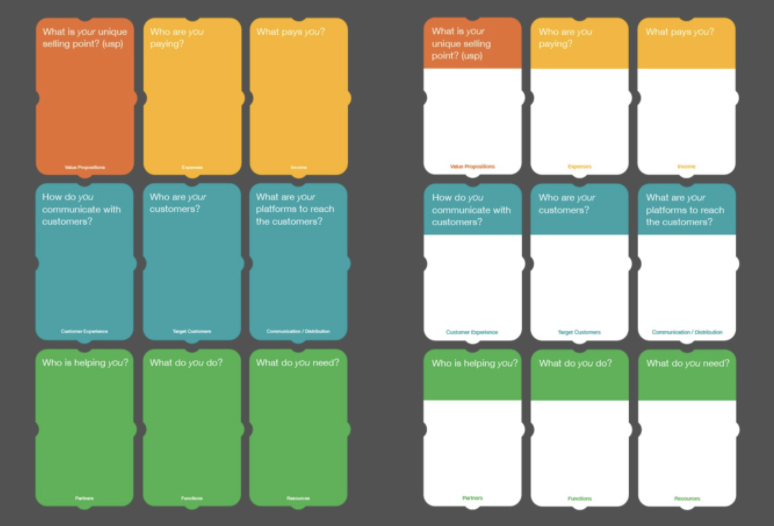
Image 3
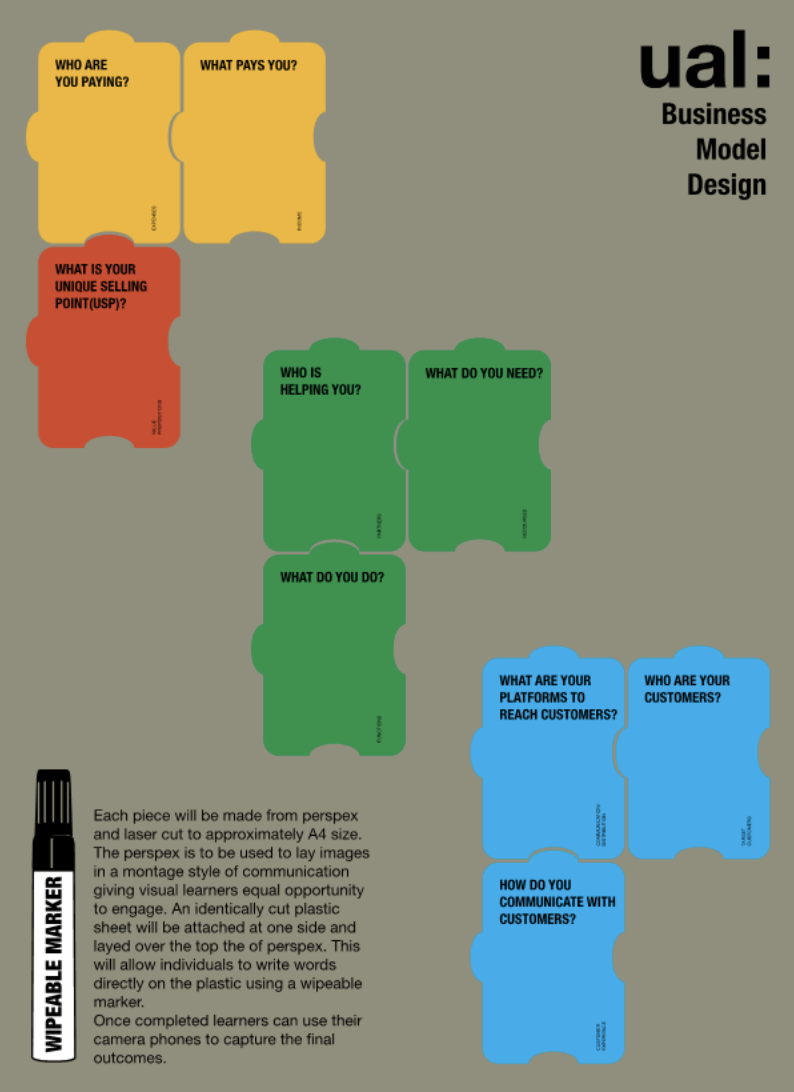
Image 4

Image 5
