Objective:
- The entrepreneur/ small business owner will appreciate the importance of cash flow forecasting (i.e. WHY it is needed)
- How to prepare a simple cash flow forecast.
Overview:
A cash flow forecast is an important tool to help an owner manage their business. Cash really is ‘King’ and every business owner needs to be aware of the timing of cash coming into and going out of their business.
Activity:
Prior to preparing a cash flow forecast, there are a couple of things to consider:-
- Be realistic i.e. don’t assume your cash income from sales will always increase month by month
- Distinguish between costs that will change every month (‘variable’ costs) and those that remain fairly constant (‘fixed’ costs)
- Plan for seasonality (some months may be busier than others)
- A good business needs a positive cash flow (i.e. where the money coming in to the business each month at least matches the amount of money going out).
- Knowing that you are likely to hit a cash flow problem in the future gives a business owner time to explore their options and to put a solution in place. This could be arranging a short-term loan or overdraft facility.
Points 4 and 5 (above) are really the essence of WHY a business owner needs to spend some time on a cash flow forecast
How to produce a simple cash flow forecast.
A simple cash flow forecast would normally take an hour or two to set up initially, then perhaps an hour a week to update the figures (with more up-to-date financial information).
An entrepreneur/ new business owner could produce a simple cash flow forecast for their business on a spread sheet such as Excel. Alternatively, there are several cash flow templates (including some that are free) that can be downloaded from the internet (see References below). Ideally, the cash flow forecast should be for a period of at least 12 months. In some instances, however, a 2 or 3 year forecast may be needed (e.g. where a new business has applied for loan finance, they would have to show to the prospective lender that the business will be able to repay the loan and interest charges).
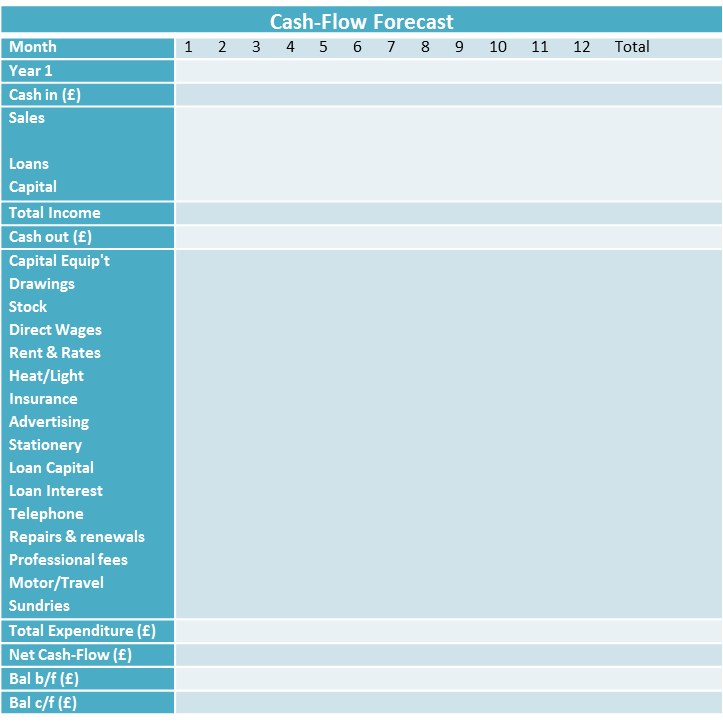
‘Cash In’ this will typically include cash received from monthly sales (allowing for any credit terms given to customers). This would be the ‘regular’ monthly income for the business. In a new, start-up business, however, there may be other sources of income such as loans, monies invested by the business owners, grants etc.
‘Cash Out’ this will typically include the expenditure undertaken by the business each month. It will include ‘regular’ monthly costs such as buying stock, paying wages (or drawings for a Sole Trader), paying rent etc. etc. In a new business start-up, in the early months it will include several ‘one-off’ costs such as buying equipment or renovating premises prior to opening a shop etc.
In some businesses the costs (i.e. cash out’) will increase as the level of monthly sales increases. For example, in a retail business, as the monthly sales grow, then the shop will have to buy more stock each month to replenish the stock that is being sold. Some costs will be incurred (i.e. result in a cash outflow) irrespective of the level of sales income. For example, if, for whatever reason, a shop has to close for several weeks they still have to pay their rent and rates expenses. In these situations, a sharp fall in cash coming in to the business can quickly result in cash flow problems. By preparing a cash flow forecast and then monitoring how well the actual ‘cash in’ and ‘cash out’ are preforming (compared to the forecast) then the business owner will be able to spot any problems in good time. They will then be able to plan how to overcome such problems before they put the future of the business at risk.
An example of a simple cash flow forecast is shown below:-
Skill Development:
By developing analytical and financial forecasting skills within entrepreneurial learners, it is possible to test assumptions and explore alternative ‘what-if’ scenarios in the context of a business start-up. This activity focuses upon the understanding of the both forecasting future cash flows and monitoring actual cash flows in the business.
Resources:
- Excel spread sheet or access to online template (example below)
- Pens, paper and calculators.
References:
Web -sites: https://www.startuploans.co.uk/business-plan-and-cashflow/- This is an example of a free cash flow template suitable for small, start-up businesses.