Objective:
- To provide students with greater knowledge, understanding and confidence regarding becoming self-employed.
- To provide students with opportunities to reflect on their own skills and strengths.
- To provide students with opportunities to reflect on the business opportunities open to them.
- To provide students with an introduction to concepts including sales, marketing, branding, financial and business planning.
- To provide students with the opportunity to develop plans and actions to take their business ideas forward.
- To provide students with a greater awareness of the business support, advice and resources available to them.
Overview:
Many students report that one of the greatest barriers at the very start of their entrepreneurial journey is identifying the first actions they need to take. Even for those equipped with a wide range of skills, a good knowledge of their sector, and even developed products and services, the move from a planned business to a real business proves a difficult one.
‘Getting Started’ is an introductory workshop which aims to address these issues.
It provides students with an opportunity to identify and reflect on their skills, to explore the relationship between their skills and the business opportunities open to them, and to test the viability of their business ideas. This is coupled with practical information regarding formalities and obligations when commencing trading and of the support structures in place for those starting-up.
The activity is designed to fit within a typical one hour lecture session, but inclusive of ample opportunities for extension, through practical activity, group discussion or independent research, and could easily form the basis of a more comprehensive scheme of work on the subject. It is designed to be appropriate for students of any level or programme of study. It was originally developed through the HEFCW funded pan-Wales Enterprise Support Programme.
Lesson plans and AV presentations for use in the delivery of the workshop can be downloaded via the link to the ‘ZONE Enterprise Hub’ web pages listed in ‘References’ and ‘Resources.’
Activity:
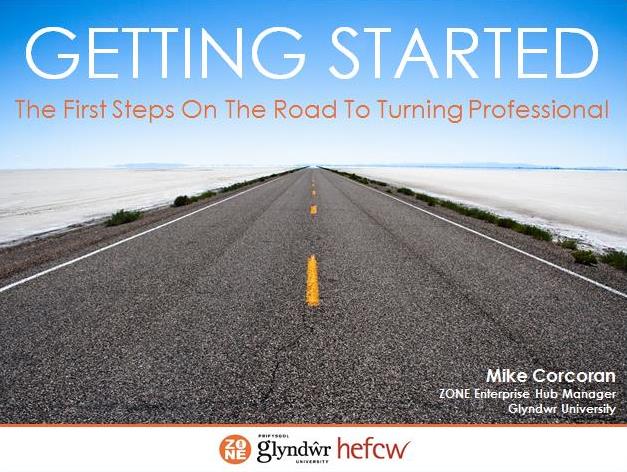
The activity follows the structure outlined in the ‘Getting Started’ PowerPoint presentation, inclusive of all links and examples.
Pre-Activity
Students are not required to prepare anything in advance of this workshop. For workshop leaders, preparation is minimal, other than ensuring supporting AV resources are displaying correctly.
Part 1 – Things to Think About
- Students are introduced to the workshop, which is broadly divided into two sections; the things to think about when starting out in business; the things to do when starting out in business.
- Workshop leader may wish to canvas the audience at this stage, regarding their own business ideas and interests.
What?
- Students begin by reflecting on their skills, and are invited to list all the skills they have (they may do this as individuals or through discussion in small groups).
- Next, students are invited to reflect on how these skills combine to produce various products and services which they are equipped to offer. For example, skills in painting, public speaking, and a rapport with young people, may equip a student to run children’s art classes.
- If time permits, students may be invited to share these ideas with the rest of the group.
- This exercise serves to help students lacking in confidence to be reminded of their abilities, helps students with pre-existing ideas for products and services reflect on how these are supported by their existing skill set, and helps students to identify opportunities which may not have previously occurred to them.
- (The activity is explored in more depth in the Workshop, ‘Breaking Problems Down and Putting Solutions Together’, available as a How To Guide)
Who For?
- Students reflect on one of the products or services they have identified, and consider who the likely customers would be for it.
- Through individual reflection, small group or class discussion, they explore appropriate costs for the product or service, how a business offering it should present itself, and how those customers identified could be reached.
- As such, the group are introduced to the concepts of market research, costing, branding and sales and marketing, with an understanding of how each of these connect to one another.
How Much?
- Students discuss some of the factors which influence the price of a product or service (For example, what determines what customers expect to pay for something, what does something cost to deliver, etc.).
- Students are introduced to the concept of cash flow, and reflect on the shift from estimating a cost per item, to monthly and annual incomes.
- Students are introduced to the concept of personal survival budgets, and consider how a business idea’s financial viability can be assessed.
- (The activity is explored in more depth in the Workshop ‘Business Planning’, available as a How To Guide).
Part 2 – Turning Thoughts Into Actions
- The second half of the workshop focussed on how, equipped with the ideas developed through the activities undertaking in the first half, practical steps can be taken to make things happen.
Making It Official
- Students discuss the benefits of having a formal business plan and feedback their ideas to their group.
- Students are provided with links to a variety of sources of information, pre-written examples and templates for producing business plans.
- Students are provided with information regarding the tax obligations of new businesses, with links to a variety of HMRC resources.
Top Tips
- Students are provided with suggestions of key things to remember as they progress their ideas over the coming weeks and months. Ideas are supported by links provided via the PowerPoint presentation.
- Namely, these key things are; To continue learning, to keep good records, to create a good working environment, to seek out opportunities through networking, volunteering and other means and to break their workload into discrete chunks, talking workloads one step at a time.
Conclusion
- The key themes covered in the workshop are re-capped.
- If time permits, informal Q and A discussion may be conducted with the audience.
Post-Activity
Getting Started is a fast-paced workshop, quickly moving through a wide variety of themes and posing many questions to students. Following on from the workshop, students may wish to explore these in their own time, or the workshop could form part of a larger scheme of work. (For example, students may develop business plans, cash flow forecasts and marketing plans, receive talks from guest speakers and entrepreneurs, engage in test trading or real-world projects etc.).
Skill Development:
Following this activity, students should have greater confidence in their abilities, greater clarity regarding their business ideas, and a better understanding of the actions they need to take to progress them.
They should be well equipped to utilise further resources and support to develop their ideas and see their businesses progress.
Resources:
- Lesson plans and PowerPoint presentations to accompany this activity can be viewed via > https://moodle.glyndwr.ac.uk/course/view.php?id=37§ion=11 , or slides downloaded here > Getting Started [PDF]
- For a deeper exploration of skills identification, see How To Guide – ‘Workshop: Breaking Problems Down and Putting Solutions Together.’
- For a deeper exploration of business planning, see How To Guide – ‘Workshop: Business Planning.’
References:
Zone Enterprise Hub, Topic: ZONE Resources. 2015. [ONLINE] Available at: https://moodle.glyndwr.ac.uk/course/view.php?id=37§ion=11 . [Accessed 05 August 2015].
Author:
- Originally produced at Glyndwr University, as an Entrepreneurial Effectiveness (EE) Session, for the Enterprise Support Programme (ESP), funded by the Higher Education Funding Council for Wales.