Objective:
- To provide participants with an opportunity to explore their ‘place’, their communities, towns or cities, local economy, and the opportunities they provide.
- To provide participants with the opportunity to think creatively about their place and develop ideas for products/services or initiatives to make it more sustainable, healthier, more prosperous, and inclusive.
- To enable participants to visualise their ideas in 3D and explore how they relate to the rest of their place.
- To enable participants to use robust models such as the business model canvas and customer profiling to test the viability of their ideas.
To enable participants to consider future careers/training/enterprise in sustainability entrepreneurship.
Overview:
Place can refer to many things; where you live or grew up – your community, village, town or city, where you work or study, and where you relax, or do hobbies or activities. You may have several places that are important to you. You know ‘Your Place’.
How does it work?
Participants explore ‘their Place’ and develop ideas for products, services, and activities to make it more sustainable, healthier, and more enterprising and prosperous. We use well established tools such as the business model canvas alongside large maps, LEGO, and Post-its for an immersive and robust enterprise and entrepreneurial experience.
Sustainability Mindset Principal Themes addressed:
SYSTEMS PERSPECTIVE
Long Term Thinking
Both-And Thinking
Inter-connections
EMOTIONAL INTELLIGENCE
Reflection Self-awareness
Enterprise Educator Framework addressed:
Developing Skills and Competencies associated with being Enterprising.
Activity:
This activity is a stand alone approach that takes place over the course of a short day (e.g. 9.30am-2.30pm) though it can be made shorter or longer depending on requirements Make Your Place challenges participants to think creatively about the future and the sustainability of their Place, the skills and qualifications they need to succeed, and how they can make a difference. It takes place as follows:
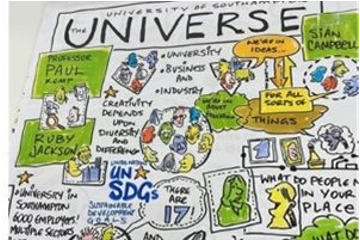
Introduction - What is Make Your Place? (45 minutes)
- An inclusive sustainable enterprise education challenge embedded in the EntreComp Framework for Enterprise Education, the Gatsby Benchmarks, and the UN Sustainable Development Goals (short introduction to each).
- Purpose of the day - Opportunity to create and innovate for:
- Your benefit
- The benefit of your city
You will:
- Explore the economy of your city – sectors, businesses, jobs, skills and training
- Develop ideas and solutions to help improve your place, now and in the future.
- Discussion about sustainability and the kinds of jobs people will do in the future, and what jobs may may no longer exist.
- Discussion about their ‘Place’ – its economy, importance in the UK, and how they can contribute. Include career aspirations, skills, any relevant local context. Opportunity for a talk by a local employer.
What will you get from today?
- An appreciation for the range of opportunities offered by your city – ‘your place’.
- The opportunity to think about how you would like to see it develop in the future, how you can contribute, and what skills you might need.
- Time and space to ‘think outside the box’.
- Work with people you know AND people you don’t know.
- Think deeply about a sector or business that interests you.
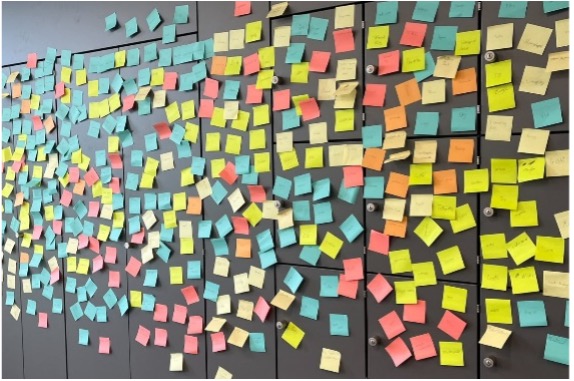
- Activity 1 - Exploring (materials – Post-it notes and space to put them up) (about 20 minutes)
Instructions
- Think about Your Place. What businesses and industries are here? Spend a few minutes jotting down your ideas then discuss them with each other. Try to get at least 15 per group.
- In front of you are sets of post-it notes.
- Write one business on each post-it, and stick it on the wall.
- Walk round and look at the Post-its. Take your time. Can you see businesses that do similar things? Any unusual businesses? Are there any missing? Are there any that you’d like to work for or with? What skills do you think you might need?
Prompts:
- Where your family/friends/other people you know, work.
- Businesses you know of because you go there or someone you know goes there.
- Organisations that provide:
o Transport
o Public sector
o Voluntary and community sector
o Places where family members or friends work
o What is your place famous for?
o Museums and art galleries
o Theatres, cinema, sports, music
After Exploring there is a short (tea/coffee/snack) break during which facilitators carry out a quick cluster analysis to identify the main sectors in their place. There is then a discussion (15 minutes) of the sectors, their differences and similarities, their contribution, and the range of jobs people do there.
2. Activity 2 - Analysing
Part 1 – Business Deep Dive (Template 1) 30 minutes
- On the table in front of you, you will see a page called Business deep dive.
- Use your knowledge of the business or sector to complete the boxes. Ask your friends or colleagues for information, use your phones or devices, ask the staff.
- Fill in as much as you can!
- Feed back to the group the name of the organisation and why they are special to their place.
Part 2 – Customer profiling - 40 minutes (Lunch usually happens about here)
(Template 2 – Who are the customers/clients/users? Template 3 – Customer portraits)
- Describe the customers in as much detail as possible on Who are the customers/clients/users? Use the Frames template to draw them– what do they look like? Think about their gender, age, jobs, families, pets, interests and hobbies. Who are their friends? Where do they live? Where do/did they go to school? Describe them in as much detail as you can to help you build up a deep understanding of who they are and what they might be interested in.
- Each group to feed back one customer – share the name of the organisation selected, one customer (show portrait) and talk about them.
3. Activity 3 - Producing
Part 1 – Small group discussion
Based on what you have learned so far, answer the following questions:
- What else might these people be interested in?
- What else might they need?
- What other activities might they like to do?
- What else might they like to see?
- What else would they pay for?
Part 2 – Invention time
(Template 4 – Draw your idea, Template 5 – Modelling Your Business Idea - Business Model Canvas)
- Based on your analysis, develop a product/service/business/place that might be of interest to these customers. It can be something that already exists but you can make it better (how?), something that doesn’t yet exist? Something that is perfect but is in the wrong place? Come up with a few ideas and then select the best. The product must be something that will also improve the sustainability of your place either through making it greener, more energy efficient, healthier, more inclusive, etc.
- Use ‘Modelling your business idea’ to think about how you could develop and implement your idea.
Part 3 – Bring your invention to life
(Materials – map of your place and Lego, or poster paper, or a report, video, Dragon’s Den style pitch, Minecraft, or any other presenting activity that fits your schedule)
Tell us about your idea. You can tell us however you want. Examples include:
- A poster
- A Dragon’s Den elevator pitch (2 minutes)
- A report
- A video
- Some photographs
- Maps and LEGO
- Minecraft
Any other ideas?
Part 4 – Evaluating: The innovation market place
(Template 6 – Evaluating ideas – please tell us what you think, Template 7 – Make Your Place Feedback Form)
- The last session of the day.
- Walk round the other tables and talk to your friends and colleagues or listen to their presentations. Tell them about your ideas, and write your thoughts about their ideas on the feedback form. Feel free to make suggestions for developing their ideas further.
- Think about the skills and abilities you can develop in order to implement these ideas – how can you develop them in the future?
- If these ideas were implemented how would they change your place? How would they make it better?
- Conclusion - Write down 3 things that made you think today.
- Fill in the feedback form to tell us your thoughts about the programme today. What have you learned and what will you use in the future?
- What went well, and where can we improve.
Skill Development:
UNESCO Sustainability competencies covered using this tool.
Cognitive/ Thinking competency
- Systems thinking competency: the ability to recognize and understand relationships, to analyse complex systems, to perceive the ways in which systems are embedded within different domains and different scales, and to deal with uncertainty.
- Anticipatory competency: the ability to understand and evaluate multiple futures – possible, probable, and desirable – and to create one’s own visions for the future, to apply the precautionary principle, to assess the consequences of actions, and to deal with risks and changes.
- Critical thinking competency: the ability to question norms, practices, and opinions; reflect on own one’s values, perceptions and actions; and take a position in the sustainability discourse.
Behavioural/ Ways of Doing competency
- Collaboration competency: the ability to learn from others; understand and respect the needs, perspectives, and actions of others (empathy); understand, relate to and be sensitive to others (empathic leadership), deal with conflicts in a group; and facilitate collaborative and participatory problem-solving.
- Integrated problem-solving competency: the overarching ability to apply different problem-solving frameworks to complex sustainability problems and develop viable, inclusive, and equitable solution that promote sustainable development – integrating the above-mentioned competencies.
Socio-emotional/ Ways of Being competency
- Self-awareness competency: the ability to reflect on one’s own role in the local community and (global) society, continually evaluate and further motivate one’s actions, and deal with one’s feelings and desires.
- Normative competency: the ability to understand and reflect on the norms and values that underlie one’s actions and to negotiate sustainability values, principles, goals and targets, in a context of conflicts of interests and trade-offs, uncertain knowledge and contradictions.
Resources:
- Resources can be found here:
Make Your Place Templates.pptx
Further information about the challenge can be found here:
References:
Bacigalupo, Margherita & Kampylis, Panagiotis & Punie, Yves & Van den Brande, Lieve. (2016). EntreComp: The Entrepreneurship Competence Framework. 10.2791/593884.
The Careers and Enterprise Company (2018) The Gatsby Benchmark Toolkit for Schools. Gatsby.org.uk
The Sustainable Development Goals Report 2023: Special Edition. United Nations Statistics Division 2023. https://unstats.un.org/sdgs/report/2023